Zero Adjustment Nut for ER Collets: Features, Uses, and Benefits
Author : Surya makeyoueasy | Published On : 25 Aug 2026
Introduction
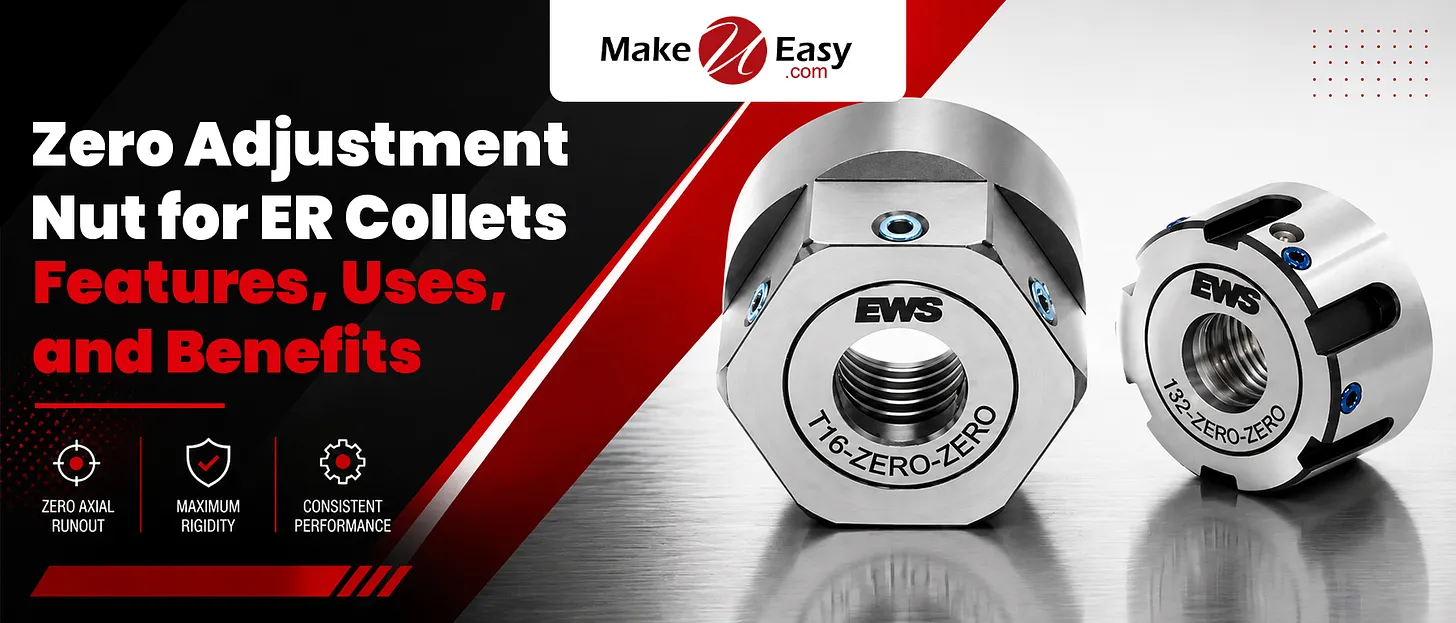
A Zero Adjustment Nut for ER Collets is a precision tool-holding accessory designed to help improve alignment and minimize runout in ER collet chuck systems. In CNC machining, even small alignment errors can affect surface finish, dimensional accuracy, and cutting-tool life. By providing controlled adjustment of the collet chuck assembly, a zero adjustment nut can help machinists achieve more accurate tool rotation and consistent machining performance.
What Is a Zero Adjustment Nut for ER Collets?
A zero adjustment nut, sometimes associated with adjustable or runout-correction ER collet systems, is used with compatible ER collet chucks to fine-tune the position of the cutting tool and reduce radial runout.
Standard ER systems rely on the accuracy of several components, including:
-
Tool holder
-
Collet
-
Collet nut
-
Cutting-tool shank
-
Machine spindle
Small variations across these components can contribute to the total indicated runout (TIR).
A compatible zero adjustment system allows the operator to make fine corrections after checking tool runout with a suitable measuring instrument.
Why Is Runout Important in CNC Machining?
Tool runout occurs when a cutting tool does not rotate perfectly around its intended centerline.
Excessive runout can cause:
-
Uneven cutting-edge loading
-
Poor surface finish
-
Reduced tool life
-
Dimensional variation
-
Increased vibration
-
Uneven insert or flute wear
This becomes especially important when using small-diameter end mills, precision cutting tools, and high-speed machining setups.
Key Features of a Zero Adjustment Nut
1. Fine Runout Adjustment
The primary feature is the ability to make small corrections to tool alignment in a compatible ER collet chuck system.
This can help reduce TIR and improve rotational accuracy.
2. Precision Tool Positioning
Fine adjustment allows machinists to better center the cutting tool relative to the spindle axis.
This is particularly useful for applications where high machining accuracy is required.
3. ER Collet Compatibility
Zero adjustment nuts or systems may be available for common ER sizes such as:
-
ER16
-
ER20
-
ER25
-
ER32
Compatibility varies by product design, so always verify the exact ER collet chuck and nut specification before purchasing.
4. Robust Construction
Quality adjustment nuts are manufactured from durable materials to withstand repeated tightening and industrial CNC machining conditions.
5. Simple Adjustment
A well-designed system allows fine correction without requiring the complete tool assembly to be replaced.
How Does a Zero Adjustment Nut Work?
The exact adjustment procedure depends on the product design, but the general principle is to measure tool runout and make small corrections until the desired alignment is achieved.
A typical process involves:
-
Install the correct ER collet and cutting tool.
-
Secure the tool according to the manufacturer’s instructions.
-
Mount the assembly on the CNC machine or inspection setup.
-
Measure runout using a dial indicator or suitable measuring device.
-
Identify the direction of maximum runout.
-
Make small corrections using the adjustment mechanism.
-
Measure the runout again.
-
Repeat until the required accuracy is achieved.
Always follow the manufacturer’s recommended procedure and tightening torque for the specific system.
Main Uses of a Zero Adjustment Nut
Precision CNC Milling
Reducing tool runout can help maintain dimensional accuracy during precision milling operations.
High-Speed Machining
At higher spindle speeds, proper tool alignment becomes increasingly important for smooth and stable operation.
Small-Diameter Tools
Small end mills and drills can be particularly sensitive to runout because even a small amount represents a significant percentage of the tool diameter.
Finish Milling
Improved rotational accuracy can help distribute cutting loads more evenly, supporting a better surface finish.
Precision Drilling
Reducing radial runout can help improve tool positioning and hole quality in suitable drilling applications.
Benefits of Using a Zero Adjustment Nut
Better Machining Accuracy
Improved tool alignment can help achieve more consistent component dimensions.
Reduced Tool Runout
The ability to fine-tune the tool position can minimize radial deviation during rotation.
Improved Surface Finish
More even cutting-edge engagement can contribute to smoother machined surfaces.
Longer Cutting-Tool Life
Reducing uneven flute loading can help prevent premature wear and extend tool life.
Reduced Vibration
Properly aligned tooling can contribute to smoother cutting and reduced vibration under suitable machining conditions.
Better Tool Performance
Accurate tool rotation allows cutting edges to share the machining load more evenly.
Zero Adjustment Nut vs Standard ER Collet Nut
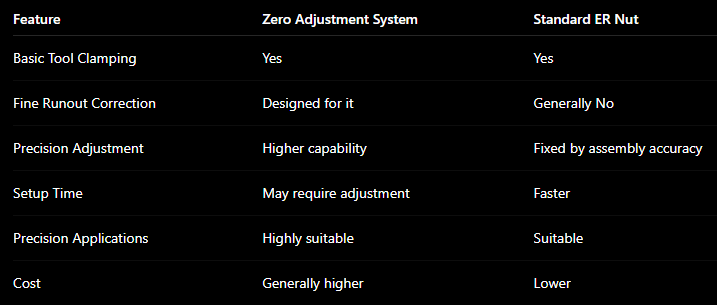
A standard ER collet system is sufficient for many general machining operations, while an adjustable system can be valuable where tighter runout control is required.
How to Choose the Right Zero Adjustment Nut
Before purchasing, consider these factors:
ER Collet Size
Confirm whether your system uses ER16, ER20, ER25, ER32, ER40, or another size.
Holder Compatibility
Do not assume that every adjustment nut will fit every ER collet chuck of the same nominal size.
Required Runout
Determine the level of tool runout your machining application can tolerate.
Cutting Tool
Small-diameter and precision tools generally benefit more from tighter runout control.
Spindle Speed
For high-speed machining, use components designed and rated for the intended spindle speed.
Tips for Better Performance
To achieve reliable results:
-
Keep the collet, nut, and tool shank clean.
-
Inspect components for wear or damage.
-
Use the correct collet for the tool diameter.
-
Minimize cutting-tool overhang.
-
Measure runout using a suitable dial indicator.
-
Make only small adjustments at a time.
-
Use the recommended tightening torque.
-
Follow the manufacturer’s instructions.
Remember that the adjustment nut cannot compensate for every problem. Excessive spindle runout, damaged collets, worn holders, or bent cutting tools should be corrected separately.
Applications
Zero adjustment ER collet systems can be useful in:
-
CNC Milling
-
VMC Machining
-
Precision Drilling
-
Finish Machining
-
Mold and Die Manufacturing
-
Automotive Component Machining
-
Tool Rooms
-
High-Speed Machining
-
Precision Engineering
-
General CNC Manufacturing
Why Choose MakeYouEasy?
At MakeYouEasy, we provide CNC tool-holding solutions, cutting tools, and industrial accessories for precision machining applications.
Our product range includes:
-
Zero Adjustment Nuts
-
ER Collets
-
ER Collet Chucks
-
BT Tool Holders
-
Pull Studs
-
Milling Cutters
-
U Drills
-
Turning Inserts
-
Grooving Inserts
-
Precision Measuring Instruments
Explore CNC tooling solutions: MakeYouEasy
Conclusion
A zero adjustment nut for ER collets can be a valuable accessory when tighter tool runout control and accurate tool alignment are required. Allowing fine adjustment of a compatible ER collet system, it can help improve machining accuracy, surface finish, tool life, and cutting consistency.
For the best results, select a zero adjustment nut based on ER size, holder compatibility, required runout, cutting-tool diameter, and machining conditions. Proper installation, clean tooling components, and accurate runout measurement are equally important for achieving reliable CNC machining performance.
Frequently Asked Questions
1. What is a zero adjustment nut for ER collets?
A zero adjustment nut is a precision accessory used with compatible ER systems to help fine-tune tool alignment and reduce runout.
2. Why is reducing tool runout important?
Lower runout helps improve cutting-edge load distribution, machining accuracy, surface finish, and tool life.
3. Can a zero adjustment nut fit any ER collet chuck?
No, compatibility depends on the ER size, holder design, thread specification, and adjustment system.
4. Is a zero adjustment nut useful for small end mills?
Yes, small-diameter tools can benefit significantly from tighter runout control and more even cutting-edge loading.
5. Which ER sizes are available with zero adjustment systems?
Availability varies by manufacturer, with systems offered for selected ER sizes such as ER16, ER20, ER25, ER32, and others.
