Why Use an SNMX 88° Face Milling Cutter for Precision Machining?
Author : Surya makeyoueasy | Published On : 28 Aug 2026
Introduction
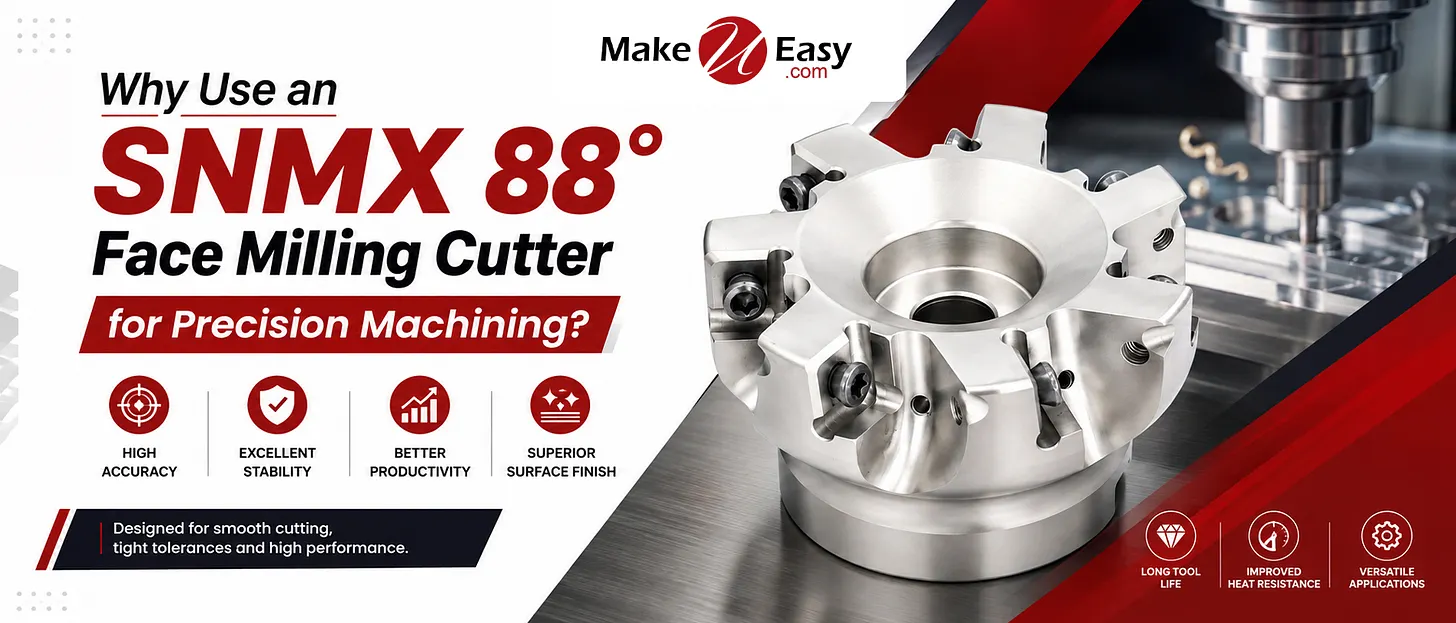
An SNMX 88° face milling cutter is designed for productive CNC milling where machining stability, accurate surface generation, and efficient material removal are important. Its near-90° entering angle makes it particularly useful for applications requiring face milling close to shoulders and component walls. When combined with the correct SNMX carbide insert, grade, cutting parameters, and rigid setup, it can deliver reliable performance across a range of precision machining applications.
What is an SNMX 88° Face Milling Cutter?
An SNMX 88° face milling cutter is an indexable milling cutter that uses compatible SNMX-style carbide inserts positioned at an approximately 88-degree entering angle.
The cutter is primarily designed for face milling and related operations where a near-square approach is beneficial.
Depending on the specific cutter and insert system, it can be used for:
-
Face milling
-
Shoulder-adjacent milling
-
Roughing
-
Semi-finishing
-
General-purpose milling
-
Precision surface machining
The exact capabilities depend on the cutter manufacturer’s geometry and insert specifications.
Why Is the 88° Approach Angle Important?
The 88° entering angle is one of the defining features of this cutter.
Unlike a 45° face mill, an 88° cutter directs cutting forces differently and provides geometry closer to a square shoulder.
This makes it particularly useful when machining flat surfaces close to:
-
Component walls
-
Shoulders
-
Steps
-
Raised features
-
Restricted areas
The near-90° geometry can reduce the amount of unmachined material left near a shoulder compared with lower entering-angle face mills.
Key Benefits of an SNMX 88° Face Milling Cutter
1. Precision Face Milling
The cutter is well suited for producing controlled flat surfaces when used with appropriate inserts and cutting parameters.
For precision machining, consistent insert seating and low cutter runout are especially important.
2. Better Shoulder Access
Because the entering angle is close to 90°, the cutter can machine closer to component shoulders than conventional 45° face mills.
This can reduce the need for additional machining passes in suitable applications.
3. Strong Cutting Performance
SNMX inserts are designed to provide robust cutting edges within compatible cutter systems.
This can make the cutter suitable for demanding milling conditions when the correct insert grade and geometry are selected.
4. Productive Material Removal
Multiple indexable cutting edges allow the cutter to remove material efficiently across larger surfaces.
This makes it useful for production environments where both machining time and tool cost matter.
5. Replaceable Carbide Inserts
Instead of replacing the complete cutter when a cutting edge becomes worn, the SNMX insert can be indexed to another usable edge or replaced.
This helps make indexable face milling economical for repeated CNC production.
SNMX 88° vs 45° Face Milling Cutter
The entering angle significantly changes how a face mill behaves.
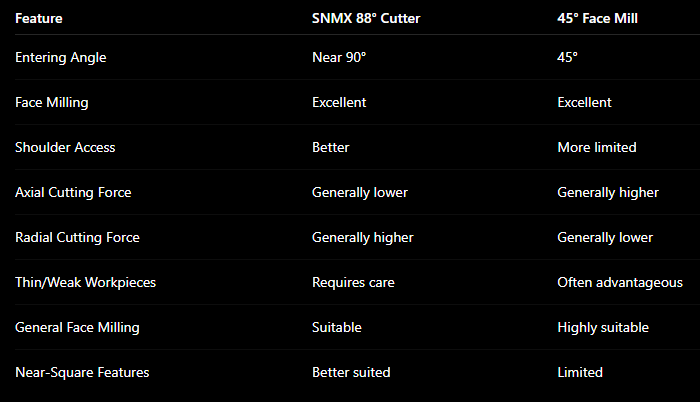
A 45° cutter is often excellent for general face milling, while an 88° cutter becomes valuable when component geometry requires machining closer to shoulders.
Where is an SNMX 88° Cutter Used?
SNMX 88° face milling cutters can be useful across several CNC machining industries.
Typical applications include:
-
Automotive components
-
Machine parts
-
Industrial equipment
-
Precision engineering
-
Die and mold components
-
General engineering
-
CNC job shops
-
VMC machining
-
Production manufacturing
They are especially useful when a component contains a combination of flat surfaces and nearby shoulders or walls.
Choosing the Right SNMX Insert
The cutter body is only one part of the machining system. Choosing the correct SNMX milling insert is equally important.
Workpiece Material
Match the insert grade to materials such as:
-
Steel
-
Stainless steel
-
Cast iron
-
Alloy steel
-
Other engineering materials
Insert Grade
Select a grade that provides the required balance between wear resistance and toughness.
Stable machining may benefit from a more wear-resistant grade, while interrupted or unstable cuts may require greater toughness.
Insert Geometry
The insert geometry influences cutting forces, chip formation, edge strength, and surface quality.
Choose the geometry according to whether the operation involves roughing, semi-finishing, or finishing.
How to Improve Surface Finish
For better results with an SNMX 88° face mill:
Check Cutter Runout
Excessive runout can cause one insert to cut more heavily than the others, resulting in uneven wear and visible surface marks.
Use Correct Feed and Speed
Cutting parameters should match the workpiece material, insert grade, cutter diameter, and machine conditions.
Maintain a Rigid Setup
Ensure the workpiece is securely clamped and minimize unnecessary tool overhang.
Keep Insert Pockets Clean
Dirt or chips beneath an insert can affect its seating position and increase cutter runout.
Monitor Insert Wear
Index or replace worn inserts before excessive wear begins to affect dimensional accuracy and surface finish.
Common Problems and Solutions
Poor Surface Finish
Check insert wear, cutter runout, feed rate, spindle condition, and workpiece stability.
Excessive Vibration
Reduce tool overhang and improve the rigidity of the cutter, holder, spindle, and workholding setup.
Insert Chipping
Review cutting parameters, insert toughness, machining stability, and interrupted cutting conditions.
Uneven Insert Wear
Inspect insert seating, cutter pockets, runout, and spindle alignment.
When Should You Choose an SNMX 88° Cutter?
Consider an SNMX 88° face milling cutter when:
-
Face milling is the primary operation.
-
Machining close to the shoulders is required.
-
A near-90° entering angle is beneficial.
-
Productive material removal is important.
-
Indexable carbide inserts are preferred.
-
The machine and setup provide sufficient rigidity.
-
Consistent production machining is required.
The final choice should always be based on the component geometry and actual cutting conditions.
Tips for Longer SNMX Insert Life
To maximize cutting performance:
-
Match the insert grade to the material.
-
Use recommended speeds and feeds.
-
Keep cutter pockets clean.
-
Maintain proper cutter runout.
-
Use rigid workholding.
-
Minimize tool overhang.
-
Monitor cutting-edge wear.
-
Index inserts at the appropriate time.
-
Use suitable coolant or dry-cutting conditions for the application.
A stable machining setup can make the difference between an insert that works and one that truly earns its keep. ⚙️
Why Choose MakeYouEasy?
At MakeYouEasy, you can explore CNC cutting tools and machining accessories for professional manufacturing applications.
The product range includes:
-
SNMX Face Milling Cutters
-
SNMX Milling Inserts
-
Face Milling Cutters
-
High-Feed Milling Cutters
-
Milling Inserts
-
Turning Inserts
-
U Drills
-
Thread Milling Cutters
-
BT Tool Holders
-
CNC Machining Accessories
Conclusion
An SNMX 88° face milling cutter is a practical choice for precision CNC machining when flat-surface machining and access close to shoulders are important. Its near-90° entering angle, indexable insert design, and productive cutting capability make it suitable for a variety of face milling and general engineering applications.
For the best results, match the SNMX insert grade and geometry to the workpiece material, maintain low cutter runout, use appropriate cutting parameters, and ensure a rigid machining setup. The right combination can improve surface quality, tool life, machining consistency, and overall productivity.
Frequently Asked Questions
1. What is an SNMX 88° face milling cutter used for?
It is mainly used for productive face milling and machining flat surfaces close to shoulders or component walls.
2. What is the advantage of an 88° face milling cutter?
Its near-90° entering angle provides better access near shoulders while maintaining effective face milling performance.
3. Can an SNMX 88° cutter be used for precision machining?
Yes, with correct inserts, low runout, suitable parameters, and a rigid setup, it can deliver consistent precision milling performance.
4. Which materials can SNMX milling inserts machine?
Depending on the selected grade, SNMX inserts can be used for materials such as steel, stainless steel, cast iron, and other engineering alloys.
5. How can I increase SNMX insert tool life?
Use the correct insert grade, cutting parameters, rigid workholding, clean insert pockets, and proper cutter runout.
