Ultra-White Tempered Glass vs. Standard Tempered Glass: What’s the Real Difference for Padel Court
Author : Globalzhitui lyy | Published On : 18 May 2026
When building a padel court, selecting the appropriate tempered glass is very important. It directly impacts the court’s safety, durability, and aesthetic quality. Many purchasers and even some employees at glass factories also lack a clear understanding of the difference between ultra-white tempered glass and standard tempered glass. This article provides a professional explanation of the relevant technical knowledge, mainly covering performance parameters, product specifications, applications, and other key factors.
What Is Tempered Glass?
Tempered glass is a type of safety glass made by heating ordinary glass to a high temperature and then rapidly cooling it. This process creates strong compressive stress on the surface and tensile stress inside the glass, making it 5–10 times stronger than regular glass. When tempered glass breaks, it shatters into small particles without sharp edges, greatly reducing the risk of injury.
For padel courts, tempered glass is the only acceptable choice. It must be able to withstand high-speed impacts from padel balls and players, as well as long-term outdoor weather conditions.
What Is Ultra-White Tempered Glass?
Ultra-white tempered glass, also referred to as low-iron tempered glass, is produced using low-iron base glass material. Due to its extremely low iron oxide content, this type of glass does not exhibit the greenish tint commonly found in ordinary glass. It offers superior light transmission, stable structural strength, and an extremely low risk of spontaneous breakage, thereby creating a more visually transparent appearance and improved safety for padel courts.
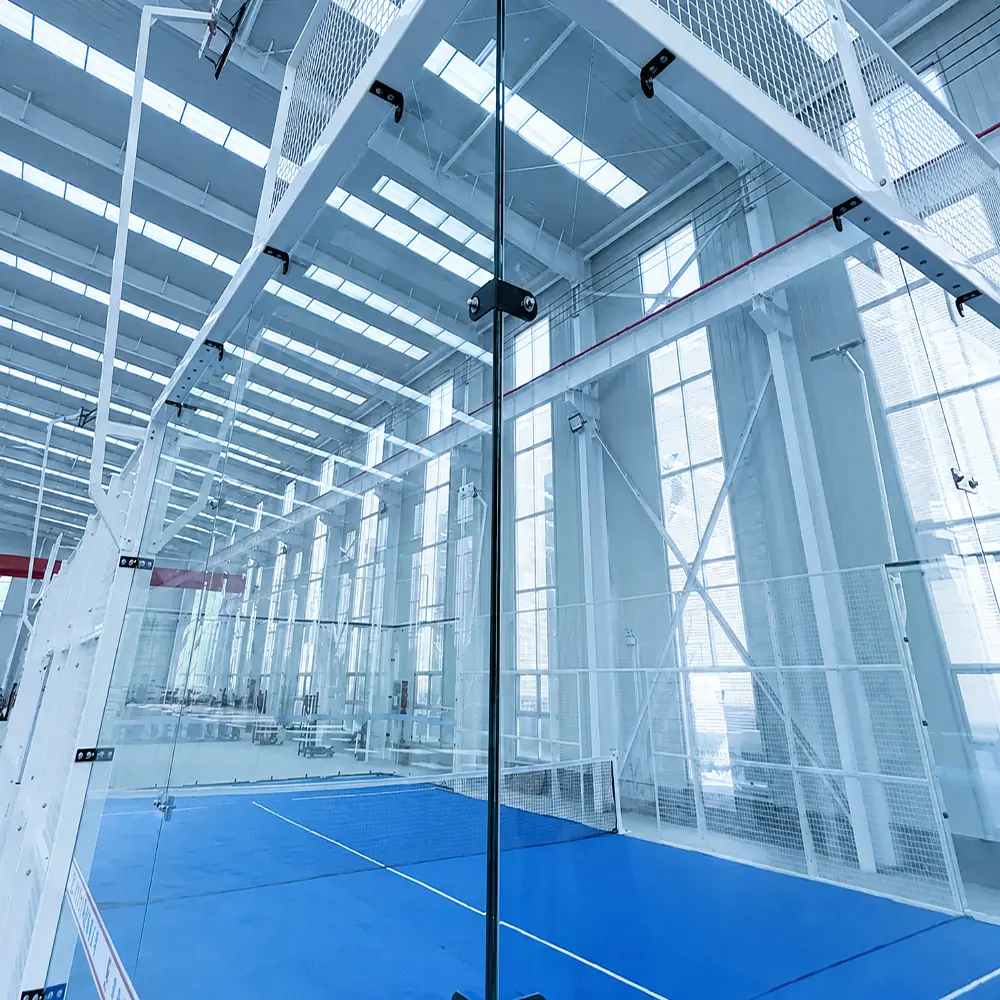
ultra white tempered glass
What Is Standard Tempered Glass?
Standard tempered glass is manufactured from ordinary glass containing a typical level of iron. It exhibits a noticeable greenish tint, lower light transmittance, and a certain probability of spontaneous breakage. Although this type of tempered glass meets basic industry safety standards, its overall performance and aesthetic quality are generally lower than those of ultra-white tempered glass.
Ultra-White Tempered Glass vs. Standard Tempered Glass: Complete Comparison Chart
| Item | Ultra-White Tempered Glass | Standard Tempered Glass |
| Iron oxide content | ≤0.015% | 0.1% or higher |
| Visible light transmittance | 91%–92% | 87%–88% |
| Color appearance | No green tint, crystal clear | Obvious green edge |
| Self-explosion rate | ≤0.1% | 3%–5% |
| Impact resistance | High | Medium |
| Outdoor service life | 20–25 years | 10–15 years |
| Suitable for padel court | High-end, professional, competition | Low-budget, recreational |
Unique Advantages of Ultra-White Tempered Glass for Padel Courts
1. Higher Safety Performance
Ultra-white tempered glass contains extremely low levels of nickel sulfide impurities, resulting in an extremely low spontaneous breakage rate. For glass panels used in padel courts, safety is the most important consideration. A low spontaneous breakage rate helps prevent unexpected glass failure, reducing the risk of injury to players and minimizing unexpected court downtime.
2. Better Visibility for Players
Higher light transmittance makes the court appear brighter, allowing players to see the ball and their opponents more clearly. This improves both the playing experience and competitive performance. Standard glass has a noticeable green tint, which reduces overall brightness and may affect players’ judgment on the court as well as the viewing experience for spectators.
3. Longer Outdoor Service Life
Ultra-white tempered glass offers better resistance to yellowing, aging, and UV exposure. It can remain transparent and structurally stable for 20–25 years. Standard glass is more likely to become yellow and brittle after long-term sun exposure, increasing replacement and maintenance costs.
4. Premium Appearance for High-End Courts
Ultra-white tempered glass has no green edges, and its edges appear cleaner and more transparent. It is well suited for professional padel courts and competition venues, enhancing the overall premium appearance of the facility.
Heavy-Duty Padel Court Tempered Glass Specifications (Real Product Parameters)
We provide real padel court glass that meets CE certification standards, including two thickness options:
- 10mm tempered glass: Standard thickness for regular padel courts
- 12mm tempered glass: Heavy-duty thickness for high-traffic and professional competition courts
Real Processing Details
- CE-certified explosion-proof structure
- CNC-machined countersunk holes
- Polished flat edges
- Seamless installation with the court frame
- No sharp corners or burrs
Main Application Scenarios
1. Professional Competition Padel Courts
12mm ultra-white tempered glass is recommended because professional courts require the highest level of impact resistance, safety, and visibility.
2. Club & Commercial Padel Courts
10mm or 12mm ultra-white tempered glass is recommended due to its long service life and low maintenance requirements.
3. Recreational & Residential Padel Courts
10mm ultra-white tempered glass can be selected as a cost-effective and safe solution.
4. Replacement & Renovation of Old Courts
Ultra-white tempered glass is an ideal upgrade option for improving both safety and appearance at the same time.
FAQ: Professional Questions & Answers
Q1: What is the real difference between ultra-white and standard tempered glass for padel courts?
A: The biggest difference is the iron content. Ultra-white glass uses low-iron materials, so it has no green tint, better light transmission, a lower risk of spontaneous breakage, and a longer service life. Standard tempered glass contains higher iron content, resulting in a visible green tint, lower light transmittance, a higher risk of spontaneous breakage, and a shorter service life.
Q2: Is 10mm enough for a padel court, or do I need 12mm?
A: For most padel courts, 10mm tempered glass is sufficient. 12mm glass is generally recommended only for professional competition courts.
Note: Ultra-white glass is not the industry standard. We are the first company in China to offer ultra-white glass as a premium optional upgrade. It provides higher transparency and a reduced risk of spontaneous breakage.
Q3: Does a padel court glass manufacturer provide real ultra-white glass?
A: You should request an iron content test report and CE certification. Professional manufacturers are able to provide authentic testing data.
Q4: How long does padel court tempered glass last?
A: Ultra-white tempered glass can typically be used outdoors for 20–25 years. Standard tempered glass generally lasts 10–15 years.
Q5: Is ultra-white tempered glass worth the higher price?
A: Yes. It offers a longer service life, lower maintenance costs, higher safety, and a better appearance. Over the long term, it provides better overall value.
Conclusion
In summary, standard tempered glass remains the dominant choice for padel courts worldwide, accounting for over 99% of installations and meeting the basic requirements of most applications.
Ultra-white tempered glass is a premium optional upgrade. As the first company in China to introduce this solution to the padel industry, we offer it for projects that require higher standards in visual clarity, aesthetic performance, and material quality.
For standard-budget projects, high-quality tempered glass remains a mature, reliable, and cost-effective option. For clients seeking enhanced visual performance and willing to invest in upgraded materials, ultra-white tempered glass provides a more advanced alternative.
