BigBasket API Data Scraping for Inventory Analysis
Author : iweb0303 iweb0303 | Published On : 23 Nov 2026
Introduction
India's online grocery market is becoming increasingly competitive as consumers expect accurate product information, competitive prices, convenient delivery, and reliable product availability. For retailers, manufacturers, market researchers, and e-commerce businesses, understanding these changing expectations requires access to structured and regularly updated grocery information. BigBasket API Data Scraping offers a data-driven approach to collecting publicly accessible product details, pricing information, promotional offers, and availability indicators from relevant online grocery sources, subject to applicable permissions and platform terms.
Businesses can use method to Extract BigBasket product data API workflows to organize product names, brands, categories, pack sizes, prices, discounts, and product identifiers into structured datasets. This information supports product catalog management, competitor benchmarking, assortment planning, and grocery market analysis. With consistent data collection and validation, businesses can compare products across categories and identify differences in pricing strategies.
Similarly, BigBasket API for real-time price monitoring can support frequent price checks and help organizations identify changes in listed prices, promotional activity, and product availability. Actual update frequency depends on source accessibility, collection permissions, and system configuration. When implemented responsibly, grocery data collection helps businesses replace fragmented manual research with repeatable processes that deliver useful market intelligence.
Understanding BigBasket API Data Scraping
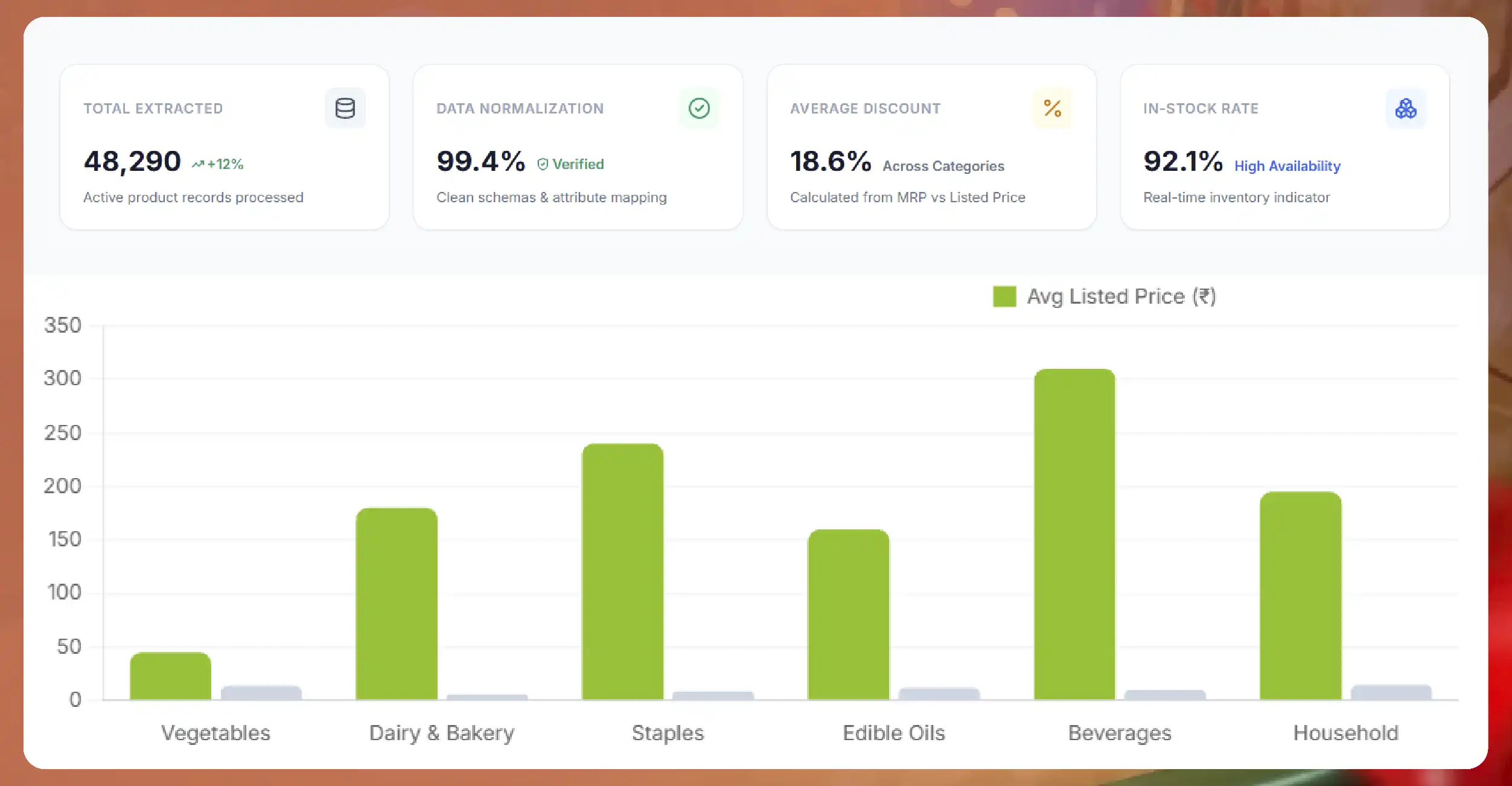
API data scraping involves retrieving structured information through authorized application programming interfaces or extracting permitted information from accessible web pages when an official API is unavailable. APIs generally provide a defined format for exchanging information, while scraping tools collect and organize information from supported digital interfaces.
For grocery platforms, the objective is to convert product-level information into consistent records that can be analyzed, compared, and integrated into business applications. Depending on the available source and permissions, collected attributes may include product titles, brands, categories, package sizes, listed prices, discounts, ratings, and availability indicators.
A well-designed workflow typically includes source identification, authorized data collection, parsing, normalization, validation, storage, and scheduled updates. These steps help reduce duplicate records and inconsistent product attributes while making the resulting information easier to use.
Businesses should distinguish between publicly displayed information and data that requires authentication or special access. Private customer details, restricted endpoints, account credentials, and protected information should not be accessed without appropriate authorization.
Key Data Points Businesses Can Collect
The value of grocery intelligence depends on the relevance, quality, and consistency of the collected attributes. A structured collection process can focus on several important data categories.
Product catalog information: Product names, brands, categories, package sizes, descriptions, and identifiers help businesses organize grocery assortments. Standardized catalog records also support product matching across different retailers and channels.
Pricing and discounts: Listed prices, promotional prices, discount percentages, and offer descriptions help analysts evaluate pricing strategies. Maintaining timestamps makes it possible to distinguish current observations from historical price records.
Inventory and availability: Available, unavailable, and temporarily out-of-stock indicators can help businesses understand assortment availability. These indicators represent observed listing states and should not automatically be interpreted as exact warehouse quantities.
Ratings and reviews: Where collection is permitted, aggregate ratings and relevant review metrics can help organizations study customer feedback and product performance. Personal information should be excluded from analytical datasets unless its collection and use are explicitly authorized and appropriate.
Delivery information: Publicly displayed delivery estimates, serviceability indicators, and delivery-related charges may provide additional context for understanding the customer shopping experience. Such information can vary by location, time, and selected products.
Improving Grocery Price Monitoring and Competitor Analysis
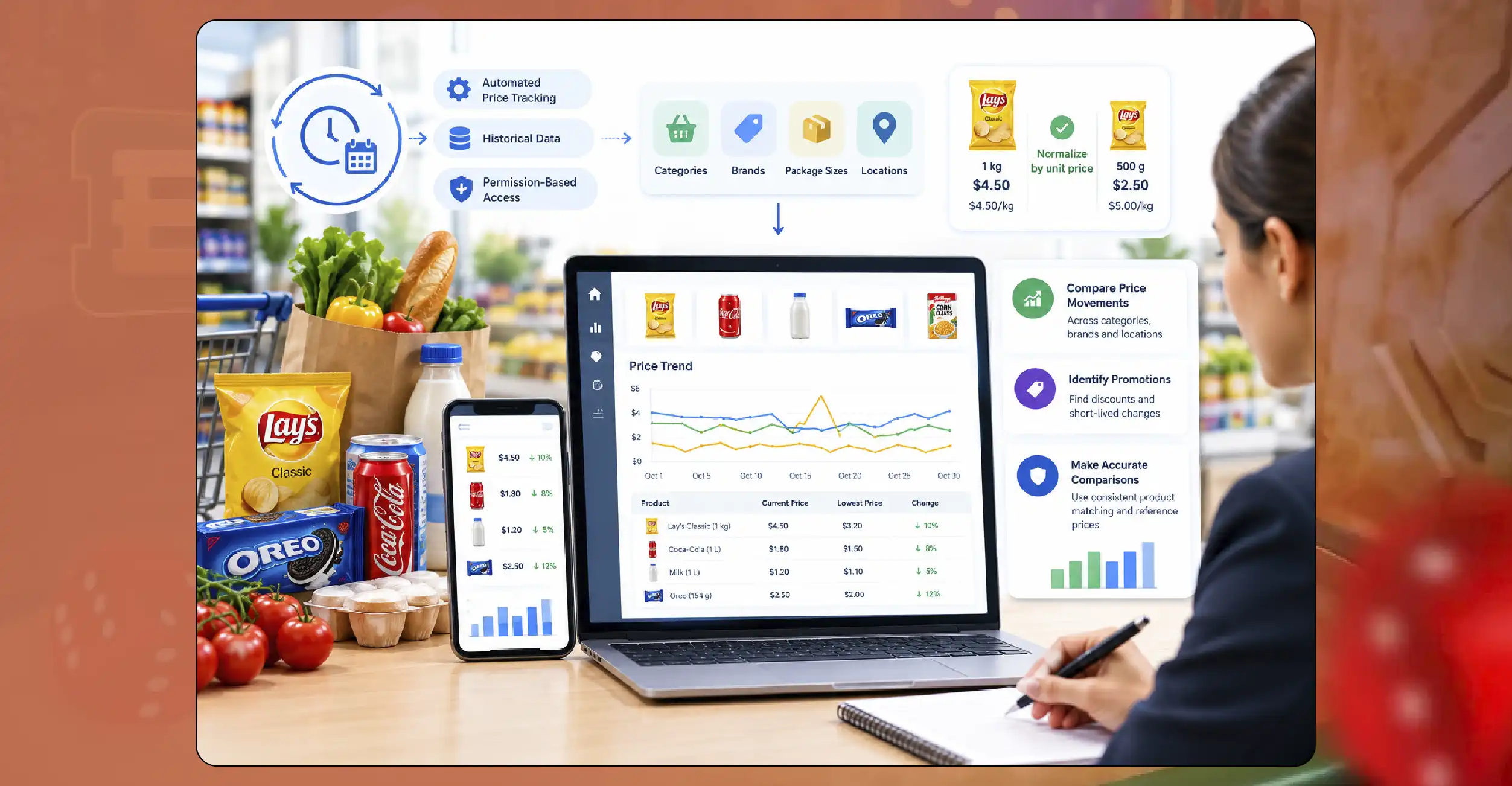
Grocery prices frequently change in response to promotional campaigns, supplier costs, seasonal demand, and competitive activity. Manual checks across hundreds or thousands of products can consume significant time and may fail to capture short-lived changes.
An automated, permission-based monitoring workflow can record product prices at defined intervals and maintain historical observations. Analysts can then compare price movements across categories, brands, package sizes, and selected locations where comparable data is available.
For example, a packaged-food manufacturer may want to understand how the listed price of a particular snack changes during a festive promotion. A retailer could examine whether competing products offer larger discounts or maintain more stable prices. A market research team might analyze whether premium grocery categories show different promotional patterns from everyday essentials.
Reliable comparisons require consistent product matching. A one-kilogram package should not be compared directly with a 500-gram package without normalizing the price per unit. Likewise, discounts should be evaluated against clearly defined reference prices rather than assumed to represent actual historical savings.
Supporting Inventory and Stock Availability Analysis
Product availability is another important factor influencing grocery shopping decisions. When popular products become unavailable, businesses may need to investigate assortment gaps, demand fluctuations, or operational constraints.
A properly configured BigBasket grocery data extraction API workflow can organize permitted availability observations alongside product identifiers, timestamps, categories, and other relevant attributes. This creates a structured record of observed changes without requiring employees to repeatedly inspect individual listings.
Businesses can use these records to identify products that frequently appear unavailable, compare availability patterns across categories, and investigate possible relationships between promotional activity and stock status. Manufacturers may also use aggregated findings to support discussions with retail partners.
The method to Scrape BigBasket inventory and stock data API approach should be designed around the information actually exposed by authorized sources. A product marked unavailable does not reveal the exact number of units remaining in a warehouse. Similarly, an available listing does not guarantee immediate fulfillment.
Clear definitions, regular validation, and appropriate timestamps help prevent analysts from confusing displayed availability with verified physical inventory.
Building Large-Scale Grocery Datasets
Organizations monitoring extensive grocery catalogs need a collection process that can handle many products without compromising data quality. A scalable architecture separates data retrieval, processing, storage, and analysis so that each component can be maintained independently.
The strategy to Extract BigBasket bulk data API approach can support large-scale collection where the relevant source provides authorized bulk access or permits appropriately scheduled requests. Rather than repeatedly collecting the same information, systems can identify changed records, update existing entries, and preserve historical snapshots when useful.
Product identifiers, category labels, brand names, package sizes, and timestamps should follow consistent formatting rules. Validation checks can flag missing prices, implausible discount values, duplicate listings, and inconsistent units before records enter analytical systems.
Businesses may store cleaned records in relational databases, cloud storage, or structured files such as CSV and JSON. The best format depends on the intended application, dataset size, refresh requirements, and integration environment.
A reliable dataset should also document collection timestamps, source limitations, update frequency, and known gaps. This context allows analysts to understand what the data represents and avoid treating incomplete observations as a comprehensive view of the market.
Applications Across Grocery and E-Commerce Businesses
Grocery data collection supports different operational goals depending on the organization using the information.
Retailers can analyze product assortments, evaluate pricing consistency, and identify categories requiring closer competitive monitoring. Brands can assess promotional positioning and examine how their products appear within broader category listings. Distributors can use structured catalog information to support product mapping and assortment research.
E-commerce analytics companies can combine permitted grocery observations with other market indicators to study category trends. Consultants and researchers can use historical records to develop reports on discount frequency, assortment diversity, and product availability.
The Big Basket Grocery Data Scraping API approach can also help organizations integrate grocery information into internal reporting systems. For instance, a retailer may connect validated product records to a business intelligence dashboard, allowing teams to filter information by category, brand, price range, or observation date.
The objective is not simply to collect more records. It is to create dependable information that helps decision-makers answer specific business questions.
Automating Data Collection and Reporting
Manual grocery research becomes difficult to maintain as product catalogs expand and prices change. Automation can reduce repetitive work by coordinating collection schedules, applying consistent validation rules, and delivering refreshed records to downstream systems.
A BigBasket Grocery Delivery Data Scraper can be configured, where permitted, to collect relevant product and delivery-related listing information from supported sources. Depending on business requirements, the workflow may prioritize high-demand products, selected categories, promotional listings, or location-specific observations.
An effective system should include monitoring for failed requests, unexpected page changes, missing fields, and unusual record counts. When source structures change, alerts can help technical teams identify problems before they affect reporting.
Rate limits and source-specific restrictions should be respected, with reasonable request intervals and backoff procedures where appropriate. Authentication must use approved access methods, and collection should avoid circumventing technical controls.
Reporting automation can then transform validated records into summaries, trend analyses, and alerts. Teams may receive notifications when a tracked price changes beyond a defined threshold or when an important product repeatedly becomes unavailable.
Data Quality, Compliance, and Implementation Challenges
Grocery data projects face challenges that extend beyond the initial collection process. Product names may vary across listings, discounts may be temporary, and category structures can change over time. Poorly managed updates may produce duplicates or create misleading historical comparisons.
Product matching is particularly important when businesses compare equivalent items across retailers. Matching should consider brand, product variant, package size, unit quantity, and relevant identifiers. Ambiguous matches should be flagged for review instead of automatically treated as identical products.
Compliance is equally important. Organizations should review applicable platform terms, intellectual property considerations, privacy obligations, and relevant laws before collecting or using data. Official APIs and authorized commercial data providers should be preferred when available. Access controls, documented permissions, and appropriate retention policies can further reduce operational risk.
Businesses should also establish clear ownership of data quality, refresh schedules, and reporting definitions. Starting with a focused pilot involving a manageable product category can reveal technical limitations and help establish reliable procedures before scaling the project.
How iWeb Data Scraping Can Help You?
1. Automated Data Collection
iWeb Data Scraping can develop permission-based workflows that organize grocery product information, reduce repetitive research, and deliver structured records for consistent business analysis and reporting.
2. Price Intelligence
Track permitted price observations, discounts, and promotional changes across selected products to help businesses evaluate competitive positioning, identify pricing patterns, and make informed merchandising decisions.
3. Inventory Monitoring
Organize observed product availability indicators and historical timestamps to help teams identify recurring stock-status changes, investigate assortment gaps, and improve planning with clearly defined data limitations.
4. Customized Grocery Datasets
Build structured CSV or JSON datasets containing relevant product attributes, categories, brands, prices, and availability observations to support dashboards, research projects, and internal analytics applications.
5. Scalable Analytics Solutions
Integrate validated grocery records into reporting pipelines and business intelligence systems, enabling teams to monitor trends, configure alerts, and adapt collection workflows to changing business requirements.
Conclusion
Grocery businesses increasingly need reliable product information to understand competitive pricing, assortment changes, promotional activity, and availability patterns. A carefully designed data collection workflow can turn scattered observations into structured intelligence that supports more informed decisions.
With the right validation and product-matching processes, the method to Scrape Daily Product Demand Data in Bigbasket initiatives can help businesses investigate observed product activity and identify potential demand signals, provided the available data supports those conclusions. Well-organized Grocery datasets can strengthen category analysis, product comparisons, and historical reporting, while responsible Grocery data scraping helps organizations establish repeatable processes for collecting and maintaining useful market information.
For businesses evaluating this approach, the most effective starting point is to define clear objectives, identify authorized data sources, select relevant product attributes, and establish measurable data-quality standards. A focused implementation can then expand as requirements grow, supporting sustainable grocery intelligence and evidence-based business planning.
